
Put Options for Beginners: Simple Strategies to Profit in a Down Market
In this article, I’ll show you how to use simple PUT option strategies to generate profit when stocks are falling.


Most new investors only think about making money when stocks go up—but seasoned traders know the real edge comes from playing both sides of the market.
In this article, I’ll show you how to use simple PUT option strategies to generate profit when stocks are falling. We’ll build on what you learned in
Option Contracts Explained: Your Guide to Key Terms and Concepts
and explore how PUT options can protect your portfolio—or even become a reliable source of income.
Need a quick refresher? Click the title above ☝️
Curious about CALL options instead? Click HERE to check that out too.
Let’s get into it.
Here are simple strategies for PUT option contracts that will help us be profitable.
Strategy 1. Selling Puts (Cash Secured Puts)
This is often called a Cash Secured Put because you are using cash as collateral to cover for selling your put option.
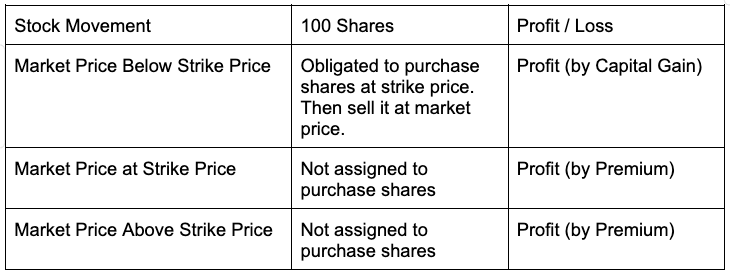
For this strategy, you have the underlying belief that this stock will go up in price. So you set your strike price slightly below the current market price. Then you are able to either collect the premium by selling a put option or purchase the share at a discount, and later sell it for a higher price.
Here are the possible scenarios.
Risk of Selling Puts (Cash Secured Puts)
There are a couple of risks to this strategy.
The first risk is potential missed opportunity. There is a possibility that the market price you are seeing for a share is the lowest that it will ever be, in which case, it would be better to buy the share at market price and hold it for the long term.
The second risk is if after you are assigned the shares, the price of the shares drops significantly to the point where it does not recover back to the purchased price.
Strategy 2. Buying Puts
The idea behind this strategy is that you have the underlying belief that this particular share is going to drop in price significantly, in which case you buy a put option against that share. Then if the share price drops, (that is cheaper than your strike price) then exercise your put option to sell your 100 shares at your strike price (which is higher than market share). Or you can just sell the put option contract you bought.
These two methods are usually used for two different purposes.
First, if you are planning on using it for option trading, then you would just sell your put option for profit. However, if you are trying to hedge (or protect your investment) then you would exercise your put option to sell off your bad investments at minimal loss.
(Let me know in the comments if you want to know more!)
But remember, since you are BUYING a put option, you are PAYING for the premium. So to actually profit, you need to share to drop enough to cover for the premium you paid.
Let me go back to using our $AMZN example for clarity.
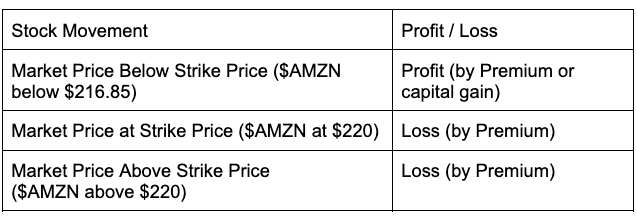
E.g. If you BUY a PUT option of $AMZN with a strike price of $220 with an expiration period of 1 month and this costs you a premium of $315. This means, $AMZN stock will have to go below $216.85 to make an actual profit.
Possible Scenarios (Used for Option Trading)
Risk of Buying Puts
So as shown in the table of possible scenarios, if you are planning on trading options using this strategy, the only way for you to make money is for $AMZN to go below $216.85.
In any other scenario, you will lose money due to the premium you purchased. It is important to remember that even if you decided to sell your option to close it early, time is against you. The value of your put option decreases as time goes by.
Summary
Now that you've learned two simple yet powerful strategies using PUT options—Selling Puts to collect premium or buy shares at a discount, and Buying Puts to profit from a stock’s decline or hedge your portfolio—you're equipped to make smarter moves even when the market dips.
Click HERE to learn about CALL options next and master both sides of the trade.
Or drop a comment for any other questions.